
On this page
Industrial skill development in India is undergoing a structural shift. As manufacturing, infrastructure, and fabrication sectors expand, organizations face a continuous challenge: how to develop technically competent, safety-aware workers at scale without compromising training quality or operational stability.
Traditional training models are increasingly strained by safety risks, resource constraints, and inconsistent learning outcomes. This has led training institutions, industries, and policymakers to explore immersive learning and simulation-based training as a prawctical response to modern workforce demands by Seabery.
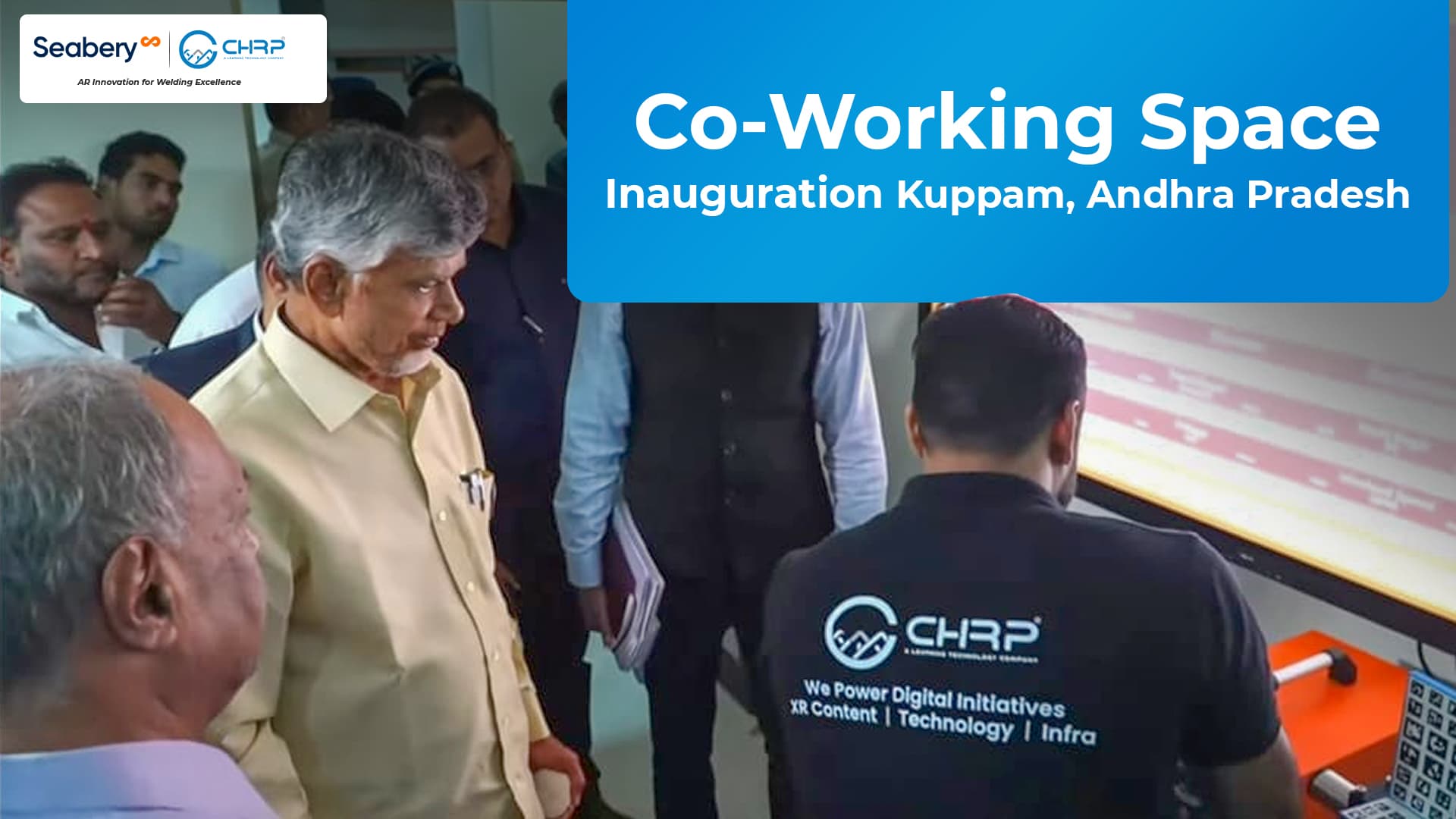
This approach was recently demonstrated during the Kuppam Co-Working Space inauguration in Andhra Pradesh, an initiative attended by the Honourable Chief Minister, Sri Nara Chandrababu Naidu Garu, which highlighted the growing role of technology-enabled learning environments in regional skill development.
The Broader Context: Skill Infrastructure and Technology Adoption
Innovation and co-working spaces are no longer limited to entrepreneurship and startups. Increasingly, they are being positioned as skill development and capability-building hubs, supporting collaboration between government bodies, training providers, and industry. Recently inaugurated Kuppam Co-Working Space reflects this direction—serving as a platform to explore how modern training technologies can complement existing education and skill initiatives. As part of the event, welding simulation technology was demonstrated to illustrate how immersive learning tools can enhance technical training while addressing safety and scalability concerns. While such demonstrations create awareness, the real value of these technologies lies in their ability to solve persistent training problems across industrial ecosystems.Core Challenges in Industrial and Welding Training
-
Safety Risks During Early Skill Acquisition
-
High Material and Operational Costs
-
Inconsistent Training Outcomes
Immersive Learning as a Practical Training Solution
Immersive learning addresses these challenges by enabling learners to practice technical skills in simulated, controlled environments before working on real operations. Rather than replacing traditional training, simulation-based learning strengthens it by:- Allowing risk-free skill practice
- Standardizing learning experiences
- Providing measurable performance data
- Reducing dependency on physical resources during early training stages
Welding Simulation Technology: How It Solves Real Training Problems
Welding simulation systems replicate real welding processes using advanced software, sensors, and performance analytics. Trainees can practice techniques repeatedly while receiving immediate, objective feedback. Key problem-solving advantages include:- Safety: Learners develop foundational skills without exposure to live welding hazards.
- Efficiency: Reduced material consumption and equipment wear
- Consistency: Standardized training scenarios across batches and locations
- Assessment: Data-driven evaluation of torch angle, speed, arc length, and accuracy