
On this page
Manufacturing companies operate in environments where safety, precision, and efficiency are critical. Employees must learn how to operate machines correctly, follow safety procedures, and respond quickly to unexpected situations. However, traditional training methods - such as classroom sessions or printed manuals - often do not prepare employees well for real factory conditions.
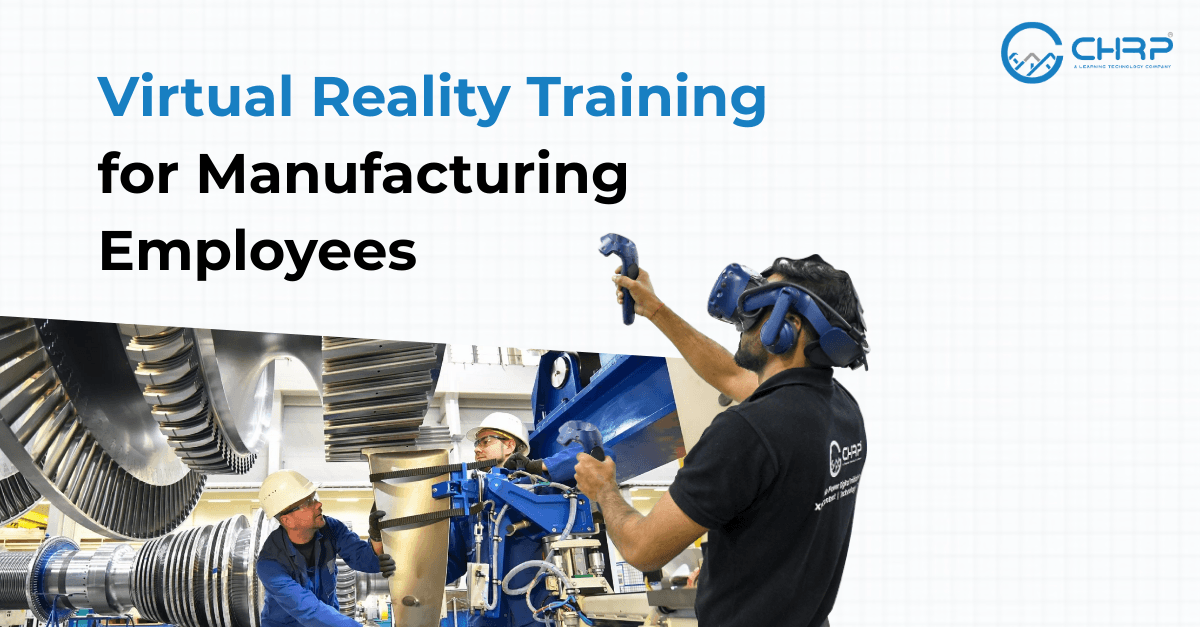
This is why many manufacturing organizations are adopting virtual reality training for manufacturing employees. Virtual reality (VR) allows workers to practice tasks and experience real workplace scenarios in a safe and controlled digital environment.
Companies like CHRP-INDIA help manufacturing businesses implement immersive training solutions that improve employee skills and workplace safety.
Challenges with Traditional Manufacturing Training
Many manufacturing companies still rely on conventional training methods. While these methods provide basic information, they often have limitations. Some common challenges include:- Employees may only observe training instead of practicing tasks.
- Training on real machines can pose safety risks for new workers.
- Classroom sessions often result in low knowledge retention.
- Different trainers may deliver inconsistent training quality.
What is Virtual Reality Training?
Virtual reality training for manufacturing employees uses VR headsets and simulation technology to create a digital version of the workplace. Employees can enter this environment and practice tasks as if they are in a real manufacturing facility. In a VR training program, employees can:- interact with machines and tools
- follow safety procedures
- complete step-by-step tasks
- experience real workplace scenarios
Practical Use Cases of VR in Manufacturing
Machine Operation Training
Operating industrial machinery requires careful attention and correct procedures. VR simulations allow employees to practice machine operation in a safe environment. Workers can learn:- how to start and stop machines
- correct operating procedures
- how to avoid common mistakes
Safety and Hazard Awareness
Manufacturing environments include many potential risks such as moving machinery, electrical systems, and heavy materials. VR training can simulate safety situations such as:- equipment malfunction
- unsafe machine handling
- incorrect use of protective gear
Maintenance and Troubleshooting Training
Maintenance teams must understand how to identify and solve equipment problems quickly. VR simulations can recreate different machine failures or operational issues. Technicians can practice:- identifying faults
- diagnosing problems
- performing correct maintenance procedures
Assembly Line Process Training
Manufacturing processes often require workers to follow precise sequences. Even small errors can affect product quality. VR training helps employees:- understand the production workflow
- practice assembly steps
- perform quality checks